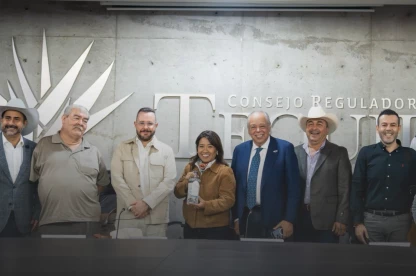
The secretary of Agriculture and Rural Development, Columba López, leads a meeting with the tequila sector to promote an action plan for the Agave-Tequila value chain.
• Joint lines of action were established to address the sector’s challenges and strengthen the sustainable development of the tequila industry.
• Agave plantation assessments, plant health, and the protection of traditional producers are among the key areas of work agreed upon.
Zapopan, Jalisco, October 29, 2026. — With the aim of implementing an action plan for the tequila sector that brings together the entire Agave-Tequila Production Chain, representatives of the Federal Government, the Government of Jalisco, the Tequila Regulatory Council (CRT), the Chamber of the Tequila Industry (CNIT), and representatives of the agroindustry held a working meeting led by Columba López Gutiérrez, Secretary of Agriculture and Rural Development of the Government of Mexico.
The meeting marks the beginning of an ongoing dialogue with the agroindustry to address the challenges facing the production chain, particularly those related to agave availability, the number of producers, the registration and updating of plantations, and the need to strengthen strategic planning, plant health, and producer protection mechanisms.
Agriculture Secretary Columba López Gutiérrez expressed the Federal Government’s willingness to work in coordination with producers, industry organizations, and state authorities on a strategy to address the challenges facing agave-growing regions.
During the meeting, the agroindustry presented initiatives it has promoted to improve conditions for agave producers. These include the Agave Responsable Social (ARS) certification mark, the geospatial monitoring platform, alternative uses for agave, tequila inventory financing, crop conversion, the development of new markets, a plant health campaign, and efforts to secure a tax incentive for agave consumption.
Alternatives for soil restoration, the development of biofertilizers, and the use of agave in other industrial applications were also discussed.
“Through the CRT, we have promoted various initiatives to minimize the impact of this period as much as possible, with particular attention to the social foundation represented by small-scale traditional producers, who have always been part of this industry, remain so today, and must continue to be part of its future,” said Aurelio López Rocha, President of the Tequila Regulatory Council.
Roberto Ciprés Cruces, President of the Chamber of the Tequila Industry, emphasized the importance of bringing together the various stakeholders in the production chain to develop joint solutions, acknowledging both the sector’s current challenges and its development opportunities, as well as the willingness of the Federal Secretary of Agriculture and Rural Development to support the agroindustry’s efforts.
Secretary Columba López highlighted the need to strengthen agave plantations and establish mechanisms that contribute to the sustainability of the production chain through a coordinated action plan.
“This is a process involving producers, technical experts, regional offices, and the state government, working together to develop an effective strategy to restore deforested areas and regions where this crop is already facing marketing challenges,” said Columba López.
In this regard, the participants proposed working with the National Service for Agrifood Health, Safety and Quality (SENASICA), in coordination with other federal authorities within their respective areas of responsibility. Regarding plant health, discussions addressed the implementation of a campaign to prevent and control regulated agave pests, particularly the agave weevil.
Eduardo Ron Ramos, Secretary of Agriculture and Rural Development of Jalisco, expressed the state government’s willingness to contribute technical capabilities and equipment.
“Our plant health agency, which works closely with SENASICA, already has drones that we are making available for a multidisciplinary program led by the Federal Government. We are placing these drones at your disposal, along with those of the different agencies involved, to begin mitigating the effects of the agave weevil in particular,” stated Eduardo Ron, head of SADER in Jalisco.
Protection of Traditional Producers
The protection of traditional producers was one of the meeting’s central priorities, with particular emphasis on the scope of the ARS (Agave Responsable Social) initiative. Opportunities to strengthen tequila sales in international markets, particularly in Asia, were also reviewed, along with research and technological development initiatives aimed at improving planning and competitiveness throughout the production chain.
“We have a proposal for the producers, and there is also a proposal for the CRT. Both have our support, as do the state governments. We can work on this together by reaching out to the relevant institutions. This is a key issue involving many producers, and we must work together,” stated Federal Secretary Columba López Gutiérrez.
At the conclusion of the meeting, the participants agreed to follow up on the topics discussed through another meeting and dedicated working groups involving authorities and industry representatives. The agenda also included a visit to an agave plantation and a tequila distillery in the municipality of El Arenal.
The Tequila Regulatory Council and the Chamber of the Tequila Industry reaffirmed the importance of maintaining an institutional collaboration agenda to advance strategic planning across the Agave-Tequila production chain, protect traditional producers, and strengthen the competitive and sustainable development of the tequila industry.
-o0o-



Contact us to learn more about CNIT memberships.
We will guide you through the process, explain what it is, how it works and what is required to become a member.
Alliances


Sponsors